



A Personal Development Plan for Busy Doctors: Start Small, Stay Consistent

Doctors are expected to keep learning while delivering care, supporting colleagues, and managing a schedule that rarely stays predictable. A personal development plan can make growth more intentional without turning every free hour into another assignment. The aim is to identify one meaningful direction, choose a manageable practice, and review what you learn along the way.
Begin with a question, not a course catalogue
It is easy to collect books, webinars, and saved articles without deciding what you want them to change. Before choosing a resource, ask: “What would make my working life or contribution to my team better over the next three months?” Your answer might involve clearer conversations, better delegation, a more sustainable schedule, or confidence in a new responsibility. Pick one area that matters now. You can return to the others later.
Keep the goal within your influence. “Improve communication” is broad; “summarize the next step at the end of complex team discussions” gives you something observable to practice. A goal can be useful even when it is not easy to measure with a number.
Write a one-page development plan
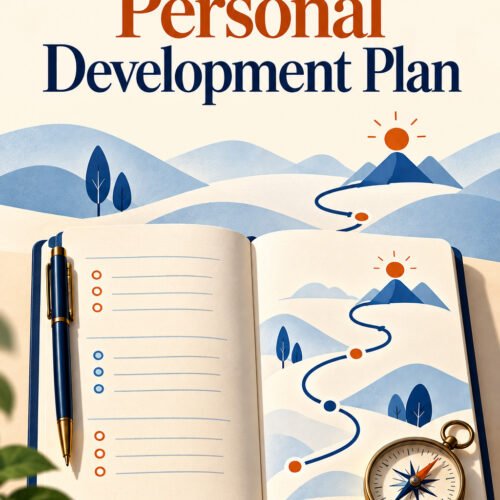
Give yourself a short plan with five parts:
- Focus: the skill or habit you want to develop.
- Reason: why this matters to your current role or future direction.
- Practice: one small action you can repeat during normal work.
- Support: a relevant book, course, colleague, mentor, or local learning opportunity.
- Review date: a point in four to six weeks when you will decide what to keep, change, or stop.
For example, a doctor interested in leadership might focus on making team meetings more useful. The weekly practice could be to open one meeting with the intended outcome and close it by confirming who owns the next action. The learning resource then supports a real behavior instead of becoming a separate project with no clear application.
Make the practice fit the work you already do
A development plan often fails when it assumes a perfect week. Choose a step small enough to survive a busy one. Ten focused minutes to read and note one useful idea may be more sustainable than an ambitious evening study schedule. If you miss a week, resume at the next opportunity; there is no need to “catch up” by doubling the workload.
Look for existing moments where the new skill belongs. A communication goal can be practiced in an existing handover. A mentoring goal can be practiced during a scheduled check-in. A reflection goal can be attached to a regular end-of-week review. This approach keeps development connected to the reality of your role.
Collect evidence of learning without collecting unnecessary data
Keep a brief private note: what did you try, what did you notice, and what would you do differently? The General Medical Council’s reflective practice guidancedescribes reflection as part of professional learning and development. You do not need a dramatic event to learn; an ordinary interaction can reveal a useful adjustment.
Protect confidentiality. Do not put identifiable patient information in a personal notebook, a general-purpose learning app, or an online course discussion. Follow your employer’s recordkeeping and privacy rules when an incident or clinical matter needs formal documentation.
Review the plan with curiosity
At the review date, ask three questions: Did the practice happen? What changed in how I worked? What made the practice easier or harder? A goal may need a smaller step, a different support resource, or more help from a manager. That is useful information, not failure.
Personal development is rarely a straight line. A clear focus, one repeatable action, and an honest review create a workable cycle. Start with a plan you can actually use next week, then let experience shape the next version.
DigitalMedSchool publishes general educational content. Adapt these ideas to your professional standards, workplace policies, and circumstances.